State seeking No Child Left Behind exemption again
Credit: John Fensterwald/EdSource Today
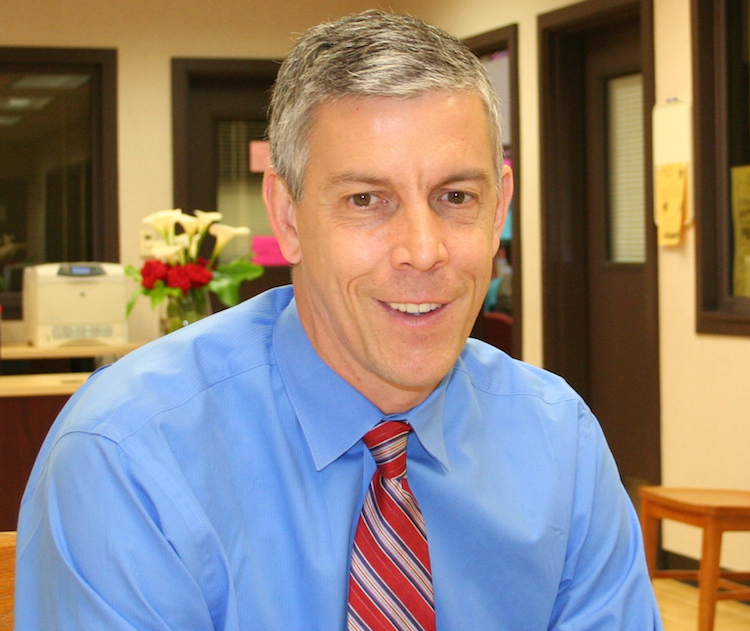
Duncan discussed a possible exemption from the No Child Left Behind law during an interview in Sunnyvale in May 2013.
 Credit: John Fensterwald/EdSource Today
Duncan discussed a possible exemption from the No Kid Left Behind constabulary during an interview in Sunnyvale in May 2013.
Note: This article was updated on May 21, 2015.The country received the exemption information technology requested in a May 19 alphabetic character from Banana U.Southward. Secretary of Education Deborah Delisle. The letter listed six conditions with the one-twelvemonth waiver.
For the 2d straight yr, California will ask the federal authorities to exempt it from using scores on the new assessments that students will take this bound to measure progress in math and English language language arts, a central requirement nether the No Child Left Behind police force.
The California Department of Instruction is hoping that the asking, which the State Board of Instruction approved concluding month, will exist granted without the conflict that ensnared California and the U.Due south. Department of Education a year ago. At that time, U.Southward. Secretary of Education Arne Duncan threatened to withhold millions of dollars in federal funding during a dispute over which tests to give students and which measurements to employ. Country education officials await to submit their proposed alternative programme to testify student progress (laid out in Item 2 of the Jan. xiii state board meeting) quondam this calendar month.
At issue in the request is what data, other than examination scores, the state's districts can use to nominally satisfy the law's centerpiece provision: the requirement that all students in grades 3 through viii be tested yearly and at least one fourth dimension in high schoolhouse and bear witness progress in math and English arts.
Under the police, students in all schools are tested, but the only schools and districts subject to penalties are those that receive federal Title I funding, awarded to schools with large numbers of low-income students. Championship I schools and districts that fail toreach academic targets must inform parents that their children can transfer to a higher-scoring school and must spend a 5th of their Title I money on exterior tutors.
Fifty-fifty some of NCLB's architects, such as Sandy Kress, an adviser to President George W. Bush, now acknowledge that requiring 100 percent proficiency was an aspirational goal that should have been reset by 2007, had Congress reauthorized the constabulary on time.
NCLB requires that each year, increasing percentages of students at a schoolhouse and a commune score at a proficient level on state tests. Under the police, base percentages were set for 2002, the year NCLB took effect, then increased each yr until reaching 100 per centum proficiency concluding year. That meant that starting last year, a Title I schoolhouse – with some exceptions – faced sanctions unless all its children scored skilful idue north math and English language linguistic communication arts.
Even some of NCLB'south architects, such as Sandy Kress, an adviser to President George W. Bush, now acknowledge that requiring 100 per centum proficiency was an aspirational goal that should have been reset past 2007, had Congress reauthorized the law on time. But for virtually a decade, Democrats and Republicans accept remained at loggerheads over what should replace information technology, then the law has remained largely intact. Final month on Capitol Colina, Republicans and Democrats resumed vigorously debating various proposals laying out the successor to NCLB. Last month, speaking to the U.S. Conference of Mayors, Duncan gave 50-50 odds that a Republican-controlled Congress could pass a bill that President Barack Obama would sign.
In California, well-nigh 90 percentage of Championship I unproblematic and middle schools and 84 per centum of high schools are already deemed in need of "Program Improvement," the status for failing to brand NCLB's annual proficiency targets two years in a row. Many schools have been in Plan Improvement for years. The remaining schools are in danger of joining them.
Most states no longer have to worry about the Program Improvement provision, even so. Duncan has granted 43 states and 7 California districts temporary waivers from NCLB'southward sanctions and given them the power to create alternative school accountability plans. Known as the CORE districts, the California seven include three of the country'due south largest unified districts – Los Angeles, Long Beach and Fresno. 2 states take had their waivers revoked and 7 didn't apply for 1. California declined to pursue a waiver in part considering Gov. Jerry Brown opposed one of the Obama administration'southward requirements: that the accountability plans include using student scores on standardized tests in evaluating teachers.
California as well clashed with federal officials last year when it discontinued the standardized tests in math and English language arts students have been taking for more than than a decade. Instead, schools administered a "field," or practise, test for the Smarter Balanced assessments, aligned with the Common Core State Standards.
State Superintendent of Public Instruction Tom Torlakson said it was more important to give districts a trial run with new online Smarter Counterbalanced assessments than test students nether the outdated state bookish standards. Duncan initially disagreed and threatened to withhold Championship I funds – he never said exactly how much – just backed down. He gave simple and middle schools a one-year reprieve from Program Improvement and said that high schools could apply graduation rates and results from the loftier school exit examination equally measures of yearly progress.
Now state didactics officials are asking for another year of grace for technical and policy reasons. The California Education Code prohibits comparing results of the previous standardized tests with the scores on the new Smarter Balanced tests in the Common Cadre that students will accept this spring. As a result, the California Section of Pedagogy argues, information technology'due south impossible to mensurate Acceptable Yearly Progress under the NCLB law.
The state'shigh school leave exam is only 25 pct aligned with the Common Core standards, and then that's another reason it is no longer a valid measure of achievement, Keric Ashley, interim deputy state superintendent of public instruction, said in an email. The State Lath of Teaching hasn't still determined how to replace the exit exam.
In identify of using educatee examination scores, the state Department of Education wants federal officials to permit California districts to utilize high school graduation rates and the participation rates of students in this spring'south 11th – form Smarter Counterbalanced tests as measures of Adequate Yearly Progress in high schools. Progress in elementary and centre schools would be based on students' attendance and their participation rate in the Smarter Counterbalanced tests.
State officials are characterizing the changes they are requesting as technical amendments to an existing plan. If their request is granted, student scores on Smarter Balanced assessments this year would be reported to the U.S. Department of Teaching, as they will be to parents and schools in California, simply would not exist used to mensurate whether a school or commune has made Adequate Yearly Progress.
Torlakson and other California officials are counting on Duncan to recognize that a successful Mutual Cadre rollout, as opposed to adherence to NCLB rules, should be the priority.
"We want to say (to federal officials), 'Look, because of the transition (to Mutual Cadre), we demand elbow room, and there is no manner to measure progress from last year to this year, so (let us) use participation rates (in the exam) as the yardstick,'" Chief Deputy State Superintendent Richard Zeiger said.
The state board approved the proposed changes earlier this month. Jenny Singh, administrator of the Bookish Accountability Unit of the California Department of Instruction, said the department had discussed the proposal with federal officials but got no indication of when or if it would be canonical.
Torlakson and the land lath consider the requirements of NCLB a sideshow to the higher priority this year to create a more relevant and useful land accountability system. "We take not focused on AYP (Adequate Yearly Progress) as a crucial level of accountability. Information technology's not a structure we want to get into" in creating a country system, said Michael Kirst, president of the Land Board of Education.
To get more reports similar this ane, click here to sign upwardly for EdSource'due south no-price daily email on latest developments in education.
blackshearreckeddens.blogspot.com
Source: https://edsource.org/2015/state-pushing-for-exemption-from-nclb-test-score-requirement/73497

Post a Comment for "State seeking No Child Left Behind exemption again"