Muhammad Ali and How Philadelphia Played a Role in His Legend
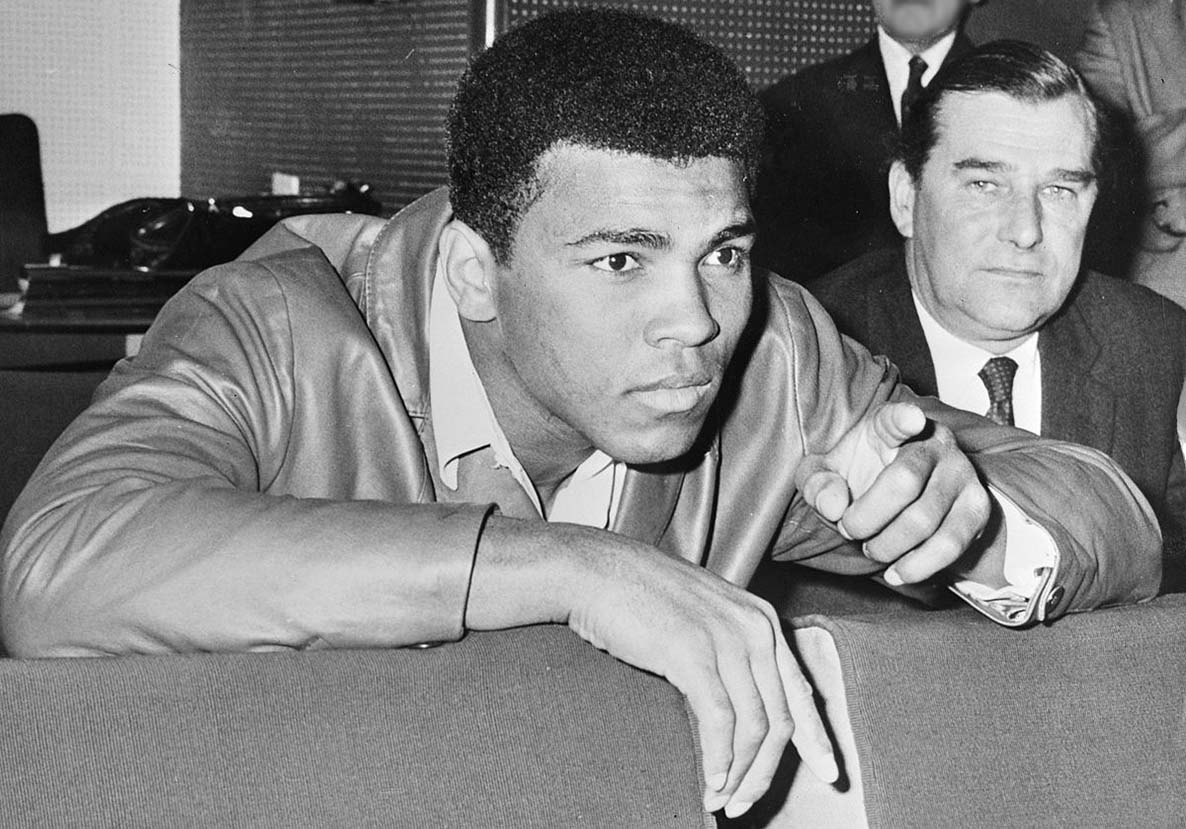
Muhammad Ali'due south Philadelphia Story
The city played a role in the making of the legend—and in the contend over the meaning of his legacy
Muhammad Ali'due south Philadelphia Story
The urban center played a function in the making of the fable—and in the debate over the significant of his legacy
Jun. 06, 2016


Last Friday dark, while Connor Barwin and several of his Eagles teammates were rocking out at Union Transfer to back up Barwin'south cause of refurbishing inner-city playgrounds, Muhammad Ali was in a Phoenix hospital, taking the terminal breaths of an epic, stirring life. Barwin and his teammates had come out for a civic cause, not an uncommon sight these days amidst athletes. In part, that'due south owing to the eloquence of Ali'southward long-ago example. Of class, the boxer'south foray off the sports pages and into the news was hardly as popular every bit the civic ventures of today's jocks.
Afterward all, on the March, 1971, night that Philly'south own Joe Frazier floored Muhammad Ali in the 15th round of the kickoff of their 3 epic fights, it is said that Richard Nixon, who would go on to be run out of the presidency as the unindicted co-conspirator of a felony burglary, jumped up and downwardly in the Oval Role, celebrating the defeat of "that draft dodger asshole."
The fight had get much more than a fight; information technology was a referendum on Nixon's Vietnam State of war. Ali was a Black Nationalist, a Muslim, a careful objector to the war who, refusing induction, stared downward five years in jail. Suspended from boxing while his case wound its fashion through the courts, he lost nearly four years in his prime earlier the Supreme Courtroom ultimately ruled in his favor. Frazier, born a sharecropper'southward son in South Carolina, had said "politics is a little out of my line" when asked almost Vietnam. He—like that otherwise bastion of liberal values, The New York Times—had refused to call Ali past annihilation other than what Ali had identified as his slave name, Cassius Clay. Ali branded Frazier an Uncle Tom, and saw to it that Frazier came to stand for the war and white America.
For many of u.s.a., Ali was our first glimpse of a brother from another planet, a wholly cocky-created, larger than life character, a testament to the joyous sense of liberty that could exist derived from simply living out loud.
I thought of Nixon when news broke that Ali had died because, when the former president passed away in 1994, at that place was much hagiography, equally at that place tends to be when we speak of the expressionless. There was talk of his statesmanship and his political acumen, but it was tougher to find in all the addicted reminiscences the Nixon of the Watergate tapes, the sneering cynic, racist and anti-semite. In the days post-obit Ali'southward decease, the plaudits take predictably come: Ali was a man of peace and love who stood for principle and served humanity. While I agree, and have long agreed, the determination runs the risk of whitewashing Ali'south revolutionary persona.
After all, the fawning media coverage of his death stands in stark dissimilarity to the portrayal of Ali in the late 1960s and early 1970s, when Ali moved starting time to Philadelphia and then to Ruddy Hill. Back then, Ali was given to united states of america every bit public enemy number one, a threat to the established order, dangerous. It's worth keeping in mind that the media that has embraced Ali these last couple of decades has done so only after he had lost the power of spoken communication due to Parkinson's Syndrome; Ali became beloved by those who had hated him just when he could no longer offend.
Mike Marqusee's Redemption Song: Muhammad Ali and the Spirit of the Sixties arguably makes the best instance for Ali as radical social force. Its rebuttal came in the form of Mark Kram's compelling Ghosts of Manila: The Fateful Blood Feud Between Muhammad Ali and Joe Frazier. Kram (whose son, Mark Kram, Jr., wrote for the Daily News and is at work on a Frazier biography) makes much of the fact that Ali couldn't locate Vietnam on a map or explicate what the conflict in Southeast Asia was all most. "For his every utterance, heavy breathing from the know-nothings to the trendy tasters of imitation revolution," Kram writes. "Seldom has a public figure of such superficial depth been more wrongly perceived—by the right and the left."
Legendary Philadelphia sports columnist Stan Hochman agreed: "I remember Ali had merely a small sense of the issues of the solar day and was willing to play the race bill of fare against another blackness man, to strength people to take sides, to root for him so he could feed off their passion." Hochman is right in the sense that what Ali did to Frazier was terrible, turning black America against him, calling him a gorilla and Uncle Tom. And Kram is right that Ali was no policy wonk.
But Ali's death has sent me scurrying dorsum to these and other books, like The Muhammad Ali Reader, and what emerges is, as I've written earlier, a complicated view of one of the 20th Century'southward most important characters. Ali may accept been a elementary boxer, simply he morphed into a moral leader of his times—warts and all. Does ane need to know policy in lodge to become an amanuensis of political change? Ali sensed something nearly the moment in which he lived, and he withstood swirling cultural winds to symbolize political truths even he might not have fully understood. Later on all, at a time when few dared oppose the Vietnam war, Ali went on Television and pithily summed upwards the illogic of the disharmonize: "I ain't got no quarrel with them Vietcong," he'd said. Watching him, I watched my Dad, a Cold War veteran, muttering to himself in his Barcalounger: "My God, he's right."
The fawning media coverage of his expiry stands in stark contrast to the portrayal of Ali in the belatedly 1960s and early on 1970s, when Ali moved first to Philadelphia and then to Cherry Hill. Back and so, Ali was given to us as public enemy number 1, a threat to the established order, unsafe.
In keeping with the need to avoid Nixon-similar hagiography, let's stipulate: Going back and rereading the Ali catechism, there's a lot to cringe over. Ali was sexist, attributable partly to the times and partly to the Nation of Islam's codified subjugation of women. And his racial taunting of Frazier—who had helped him out financially when Ali'southward court case had all simply bankrupted him—was unseemly.
But—and this is what Kram, Hochman, and other revisionists miss—it was also political. It tin't be separated from the context of the times. Marqusee documents that Ali's entreatment of his case against the government cited the exclusion of blacks from draft boards. "In the 2 states dealing with his case, Kentucky and Texas," he writes, "only 0.2 percent and one.1 percent of draft board members were blackness, although blacks made upward seven.1 percent and 12.iv percent of their respective populations." Ali was pilloried on editorial pages, hated among whites, and even Jackie Robinson criticized him. To make ends run into during his adjournment, he went on a college speaking tour, where he'd posit the war equally part of a larger racial argument. "We take been brainwashed," Ali said at Howard University. "Even Tarzan, king of the jungle, in black Africa, is white."
No matter what the obits say this week, make no mistake: Ali in his prime was an unpopular radical, deemed far outside mainstream America. When, with Malcolm 10 by his side, Ali announced after first winning the heavyweight championship in 1964 that he was a member of the Nation of Islam and would be irresolute his name, he said something few athletes take ever told a media throng, earlier or since: "I don't have to be what you desire me to be," an overt political argument. Into this context came Frazier, insisting on calling Ali "Cassius Dirt," drawing the battle lines. Frazier was the institution, without fifty-fifty knowing it. "Joe, in his innocence, was representing white America—in his innocence," football great turned activist Jim Brown said in the 2000 HBO documentary Ali-Frazier I…One Nation Divisible, almost the feud between the two men. "And that will incense a revolutionary who is trying to make modify and knows doggone well there'southward no equality."
Ali moved to Philly from Chicago in 1970, during his adjournment from the sport for refusing induction into the military. Stripped of his title and his passport, he watched equally Frazier became champion, possessor of what he saw equally his title. Some thought the motion to Philly was all about getting in Frazier's head, invading his home turf. After all, if Ali was not the inventor of trash talk, he was certainly its near historic practitioner. Earlier a unmarried punch was thrown, he'd accept up residence in his opponents' heads, similar that time he obtained Frazier'south hotel room number the night earlier ane of their fights. "Yous fix to dice tomorrow, Joe Frazier?" he said when Frazier picked up the phone.
Ali stalked his nemesis around town, going so far as to run where Frazier would run in Fairmount Park. During ane of the run-ins Ali orchestrated, an exasperated Frazier said, "What you in Philly for? Philly's my boondocks." "Oh, I simply want to go a piddling closer to you lot, honey," Ali replied.
Ali had been staying in Overbrook, simply off City Line Avenue in Philadelphia—I remember him signing kids' autographs for hours at what was so the City Line Marriott—when his close friend Major Coxson convinced him to move to Cherry Hill. As reported by Maury Z. Levy in a 1975 Philadelphia magazine slice, the reason was—in a comforting nod to how, the more things change, the more they stay the same—the Philly wage tax, which would take cost the then-former gnaw considerably. Coxson, who was a shady South Jersey graphic symbol, a candidate for Camden mayor who had washed serious jail time and who had quipped, "Most politicians end upward in jail anyhow, so I've got a head first"—would afterwards exist executed in his domicile, gangland style. After his murder, Ali left the area, quickly.
According to Levy'due south piece, in the 3 years he was here, Ali was active in the life of Philly, trying to help at-home racial strife at South Philly's Tasker Homes, visiting hospitals, hiring downward-on-their-luck expanse fighters. "One day he got into preparation army camp belatedly because he heard a thing on the news most this niggling kid who had gotten his legs cut off past a train," Levy writes. "He went to the hospital, unannounced, and held the child in his arms and started dancing around. 'This,' he said, 'is the Ali shuffle. And i day y'all're gonna be doing it yourself.'"
When the Supreme Court found in his favor in 1970, it gear up the fight of the century, a showdown between the ii undefeated titans. Frazier was the champ, but Ali, who hadn't lost his championship in the band, referred to himself as "the people's champ." Frazier was in no hurry to fight, so Ali stalked his nemesis around town, going so far as to run where Frazier would run in Fairmount Park. (Fairmount Park comes upward in battle lore at least one other time, when Sonny Liston, the bad boy gnaw Ali dethroned in 1964, was arrested in the park for impersonating a police officeholder by flagging down a female person driver with a flashlight; though charges were never filed, the episode prompted Liston to flee town and say, "I'd rather be a lamppost in Denver than the mayor in Philadelphia.")
During one of the run-ins Ali orchestrated, an exasperated Frazier said, "What you in Philly for? Philly'southward my boondocks."
"Oh, I just want to get a fiddling closer to you lot, dear," Ali replied.
1 day, the two met up and about came to blows and then and at that place. They agreed to fight in a Police Athletic League gym; give-and-take got out. Over one,000 people turned up for the spectacle, as did Ali. Frazier was a no-show. Ali held court. "He wants to show he can whup me," Ali shouted. "He says he's the champ. Allow him prove it here in the ghetto where the colored folks can see it."
In an interview in a publication chosen The Black Scholar, Ali explicitly made the connection between Frazier and his ain politics, seeing his opponent every bit a stand-in for his oppressors. "I was determined to be one nigger that the white homo didn't get," he said. "…I hate to see black women and men, once they get prestige and greatness, where they tin go into ghettos and selection upwardly little blackness babies and make them feel proficient, to go leave and marry somebody else and put the money in that race…Now the white man's got the heavyweight champion—Joe Frazier'southward got a white girlfriend."
When Esquire magazine gave Ali five pages to fill, he published a manifesto. "[Black athletes should] take all this fame the white man gave to us because nosotros fought for his entertainment, and we can turn information technology around," he wrote. "Instead of beating up each other…we volition employ our fame for freedom." Ali suggested diverting $25 million from war machine spending to build homes in deep southern states. "Each black man who needs it will be given a habitation," he wrote. "Now, black people, we're not repaying you. We ain't giving you lot nothing. We're guilty. We owe information technology to you lot."
Subsequently boxing, he institute meaning across the orbit of his own ego, telling his authorized biographer Thomas Hauser in 1990 that boxing bored him at present. "Now my life is actually starting," he said. "Fighting injustice, fighting racism, fighting crime, fighting illiteracy, fighting poverty, using this face the globe knows and then well and going out and fighting for truth and different causes."
Can yous imagine a pro athlete making an argument for reparations today? Of course, outside agitators accept always paved the way for inside modify agents. In that sense, there'due south a directly line from Ali to someone similar Barwin today; as Jesse Jackson used to discover, tree shakers beget jelly makers.
Even if, in hindsight, y'all find Ali's rhetoric off-putting—the 1975 Playboy interview in the Ali Reader is total of statements some would classify equally "anti-white"—there's no doubting his stunning originality. He lived life as though he were starring in his own picture show, a showman's showman, and yet he didn't fall casualty to the narcissism of celebrity. In fact, later on boxing, stricken with Parkinson's, he found meaning beyond the orbit of his own ego, telling his authorized biographer Thomas Hauser in 1990 that boxing bored him now. "Now my life is really starting," he said. "Fighting injustice, fighting racism, fighting criminal offence, fighting illiteracy, fighting poverty, using this face the world knows so well and going out and fighting for truth and dissimilar causes."
For many of us, Ali was our outset glimpse of a brother from another planet, a wholly self-created, larger than life character, a testament to the joyous sense of liberty that could be derived from simply living out loud.
Ali was, argued legendary New York art director and advertizement man George Lois in his book, Ali Rap, the father of hip-hop: "A pugilistic jester whose verbal jabs made more headlines than his punches in the ring, his doggerel was an upscale version of street trash talk, the first time whites had always heard such versifying—becoming the first rapper, the precursor to Tupac and Jay-Z. His start-person rhymes and rhythms extolling his hubris were hilarious hip-hop, decades before Run D.M.C., Rakim and LL Cool J. His style, his desecrating oral cavity, his cute irrationality, his principled, even prophetic stand up confronting the Vietnam State of war, all added to his credentials as a true-born slayer of authority."
Ali'south creativity in the band was rivaled past the creativity with which he lived; his whole life was a kind of performance fine art, with him winking at his audition all the while. Equally Lois documents, he'd often burst into poesy, sometimes extemporaneously; his nigh famous, of class, was "Float like a butterfly/Sting like a bee/ His easily can't hit/What his eyes can't see," but at that place were many more, including: "I've wrestled with alligators/I've tussled with a whale/I done handcuffed lightning/And thrown thunder in jail/Yous know I'm bad/Only last week, I murdered a rock/Injured a stone/Hospitalized a brick/I'g so mean, I brand medicine ill."
But possibly it'due south nearly plumbing equipment to finish with Ali'due south poem about none other than his great Philly rival, Frazier, which captures and then many facets of his personality—the bemusement, the showmanship, the deftness of his language. Watch below for a glimpse of a truthful American original:

blackshearreckeddens.blogspot.com
Source: https://thephiladelphiacitizen.org/muhammad-ali-philadelphia-story/

Post a Comment for "Muhammad Ali and How Philadelphia Played a Role in His Legend"